The well-respected publication Scientific American (“SA”) released an article titled “Why Hostility Can Bring People Closer Together – The Surprising Power of Hostile Mediators.” At first glance I thought I was reading an article from the infamous publication The Onion that often prints false and ridiculous stories such as one I saw recently headlined “Judge Orders Columbus Statue Removed and Melted Down Into Pinkie Rings for Local Italians.” Having had a Sicilian father who proudly donned a pinkie ring, I found this one to be at least semi-believable and at worst, deserving of a chuckle. I could not however wrap my head around what SA was suggesting about the benefits of stress and hostility in the dispute resolution process.
The SA article acknowledges from the outset that people in conflict often turn to mediation to resolve difficult disputes and that traditional effective mediation practices suggest that a mediator should:
“…listen attentively to each person involved and express empathy with their viewpoints, no matter how different from one another they are. Mediators are advised to avoid appearing to favor the ideas of one side, and to make each person involved feel at ease and confident that they are being understood. Establishing this rapport is a commonly espoused ‘best practice’ for gaining trust and facilitating conflict resolution. Indeed, surveys of professional mediators confirm that they commonly adopt these recommended tactics.”
Then, SA goes on to suggest that from according to their research:
“…to effectively help people resolve their conflicts, mediators should adopt a hostile attitude rather than a calming one. A hostile mediator, we find, induces better results than a nice one.”
Um, what?
In a number of experiments, SA created situations where a mediator had a “nice” approach and ones where the mediator acted hostile, aggressive and somewhat rude. Across different types of conflicts, SA found that 85 percent of the parties who dealt with a hostile mediator reached an agreement with their counterpart, as compared to only 59 percent of those in the presence of a nice mediator. SA postulated that hostility can pay off in certain contexts when it is used to create a common enemy (the rude mediator) for people who are not seeing eye to eye.
Many of us have seen a ‘common enemy’ play out as children when fighting with our siblings. . We have all gone running to a parent to complain about a sibling’s behavior, only to find our sister or brother already at the parent’s bedroom door telling on us for our bad behavior. If you grew up in the 1970s like I did (and even more so if you had a Sicilian father), you often got a response from the parent, something like: “If I have to come out of this room to deal with the both of you, neither or you are going to be happy!”
That’s when the squabbling siblings got quiet, looked each other knowingly in the eye, and silently agreed to slink off, muttering something like “geez dad … what is his problem.” Fight resolved, as the siblings had the common experience of the good ole’ 1970s style parental threat. At that moment, they are finally on the same page. Dad is the enemy, not one of them.
While I certainly can play the part of a hostile, aggressive and rude mediator, there are better ways in my humble opinion to help people resolve their problems, as competing science also strongly suggests that negativity, stress and riling people up when they are already embroiled in a dispute can make things worse. While attorneys may be somewhat immune to this kind of behavior after many years of litigating, the average human being is not, and does not find it pleasant or motivating.
When people in conflict feel distressed, as is often the case in a mediation, the addition of a hostile/common enemy mediator can have the opposite effect that the SA article is suggesting. Unchecked stress and anxiety kick off the fight or flight responses in humans that rapidly affect neural functioning in several brain regions critical for learning and memory, such as the hippocampus, amygdala and prefrontal cortex. Frankly, people generally do a piss-poor job of thinking clearly, thinking creatively and staying calm when they feel like they are being treated poorly. Also, they are miserable. This is no way to resolve a dispute.
What does make all the difference in the world when helping people resolve their disputes? Humor. Humility. Respect. Helping people understand and forgive themselves for making mistakes. Besides being the right way to treat people, this treatment serves to soothe the nervous system, rather than not set it on fire.
Many times, I have seen people get very worked up in a mediation. When things heat up, I can plainly see that the fight-or-flight response is about to take over. Once this starts, I am now fighting on a number of fronts to resolve the matter. People start to lose their ability to think clearly. In these moments, I have gotten very quiet and then, without warning, have told a very bad “dad joke.” These jokes are often followed by a brief silence, eye-rolling by the poor recipient of the joke, and then laughter. The laughter is never because the joke is funny, but because these jokes are often very, very bad and unexpected. I don’t tell the joke to make people laugh but — rather, I am hoping to bump people’s brains ever so slightly off the fight- or- flight track. When I introduce humor, I can literally see that the upset person’s biology is back to working for them and not against them. I can visibly see people calm down, relax their body, take a deep breath and get back on task. Calm and lighthearted people do a much better job finding a way out of conflict. Many times after I have told a bad joke, people will look one up themselves and tell it to me at some point in the mediation. The people who play along, and let their fight- or- flight side breathe, leave the mediation feeling much better than when they came in , even if they have had to pay money they did not want to pay to resolve a dispute, or they take less than they think they are entitled to.
Sure, I can be tough when the situation calls for it. However, the last thing I want is for people to leave a mediation feeling bullied, blamed and in need of a stiff drink after. Creating a common enemy out of a grumpy parent is fine when you are 10 years old, but adult problems call for adult solutions, even if they are helped along by bad dad jokes.

Deb Graceffa, Esq.
For Attorneys
Tools, Info and Content To Prep For A Successful Mediation.
Recent Posts
CAR Mediator Spotlight:

DAILY JOURNAL
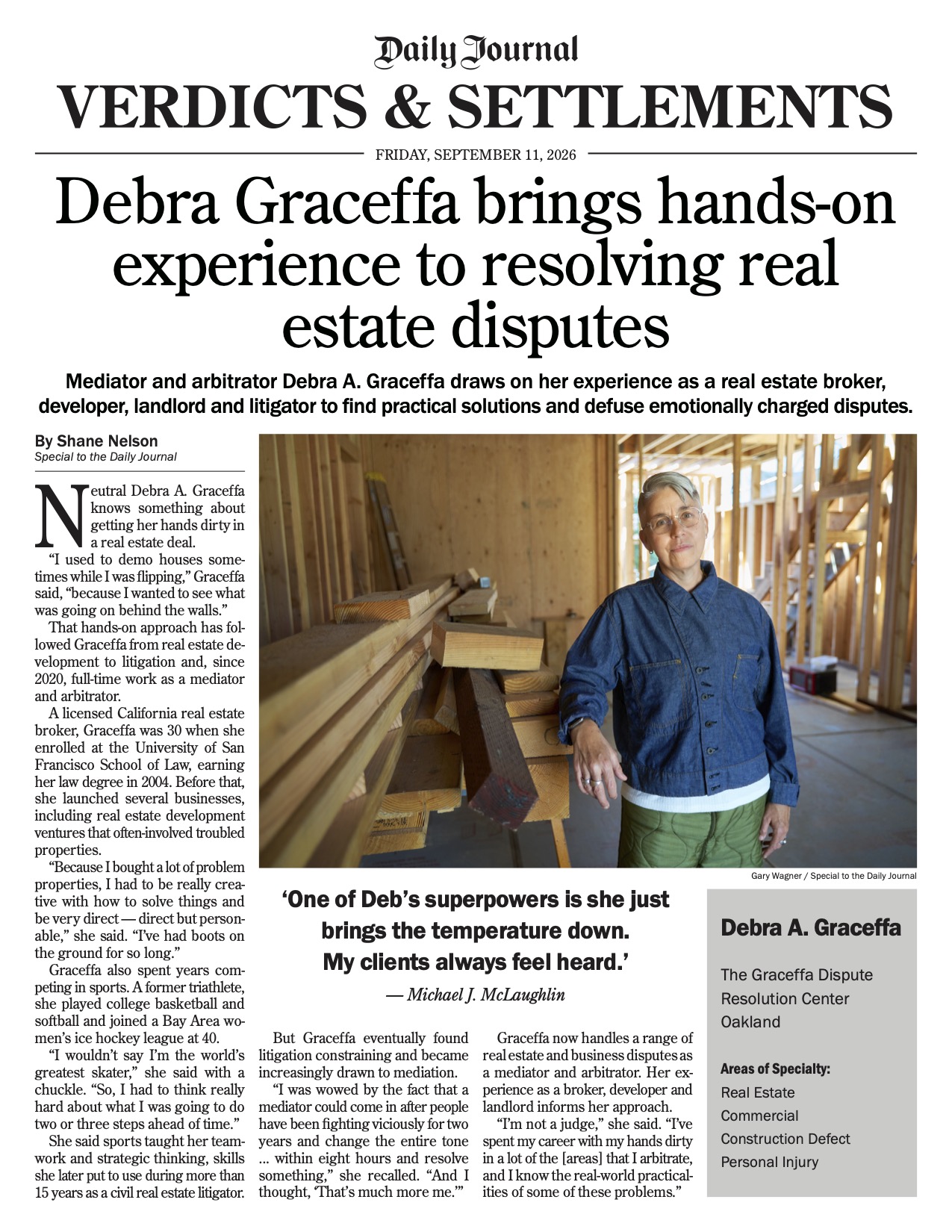
SF DAILY JOURNAL
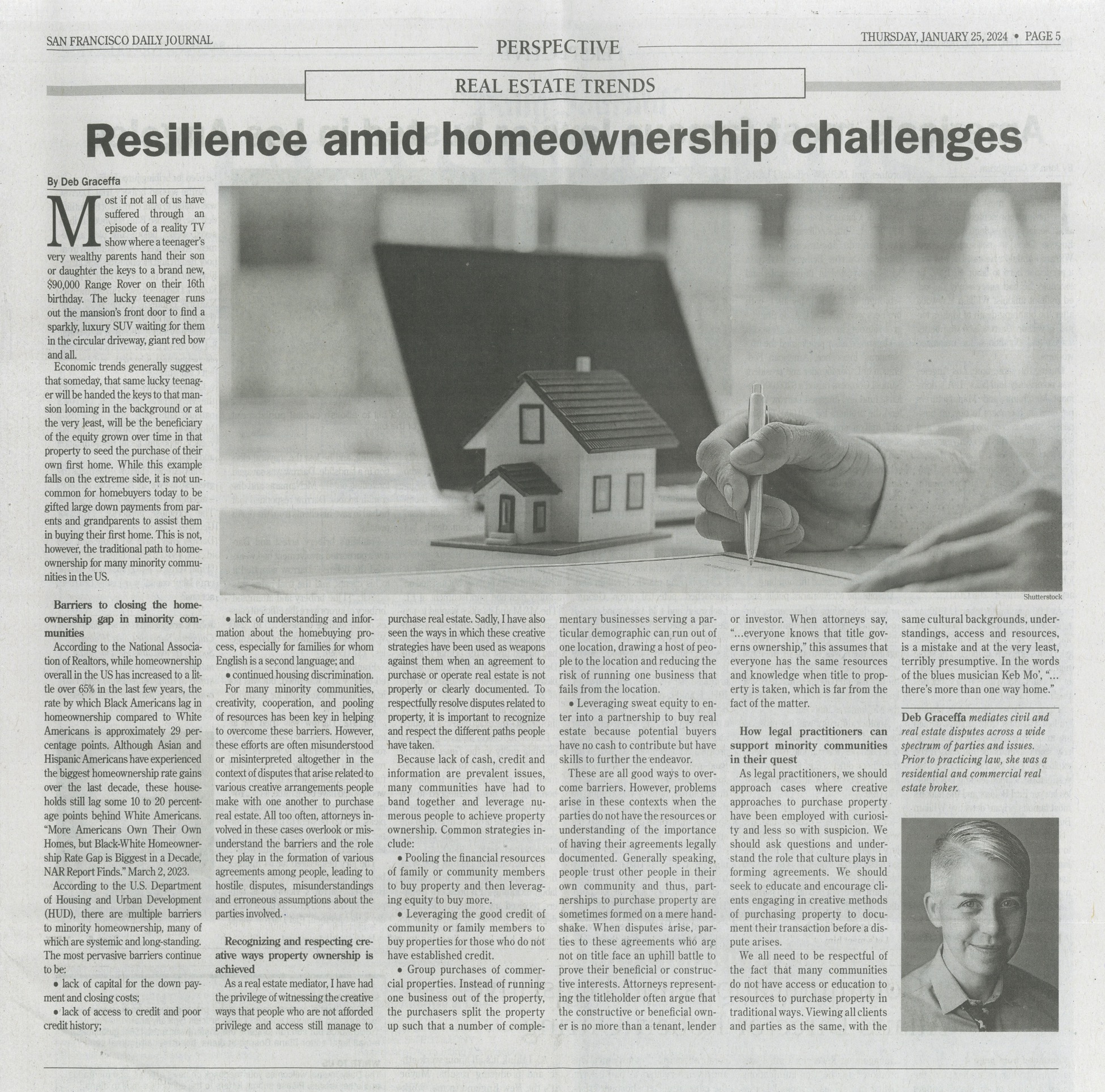
LA DAILY JOURNAL